Case study · Scenario based eLearning
Earn Back His Trust
A Storyline course that teaches new hires to calm a frustrated customer with the 3 A's, ending in a live AI practice call that scores the learner's own words.
- My role
- Instructional designer and developer
- Audience
- New hires in their first 90 days in customer facing roles
- Format
- Self guided branching scenario plus a live AI practice round
- Tools
- Articulate Storyline 360, Canva, Cloudflare Workers, Google Gemini
About the client: Tessaro Support Partners and its team lead, Dana Reyes, are fictional. The performance problem, the 3 A's, and the judgment behind each decision come from my own years in customer support and training.
The problem
New hires escalate calls to a supervisor when they can't calm a frustrated customer. Every unnecessary escalation costs a supervisor's time and leaves the customer more upset. The business goal for this course is to reduce new hire escalations.
I approached the needs analysis as a root cause analysis. Escalations happen when an agent breaks down in one of three places: they don't acknowledge the customer, they don't align with the customer, or they don't assure the customer with a plan. New hires usually know the policy. What they lack is practice saying the right thing under pressure. That makes this a skill gap, not a knowledge gap, and a skill gap calls for practice with realistic consequences rather than a list of tips.
The approach: the 3 A's
Acknowledge
Restate what happened and how it's affecting them before you fix anything.
Align
Put yourself on the customer's side and show how the policy works for them.
Assure
Give the what, the when, and how you'll follow through.
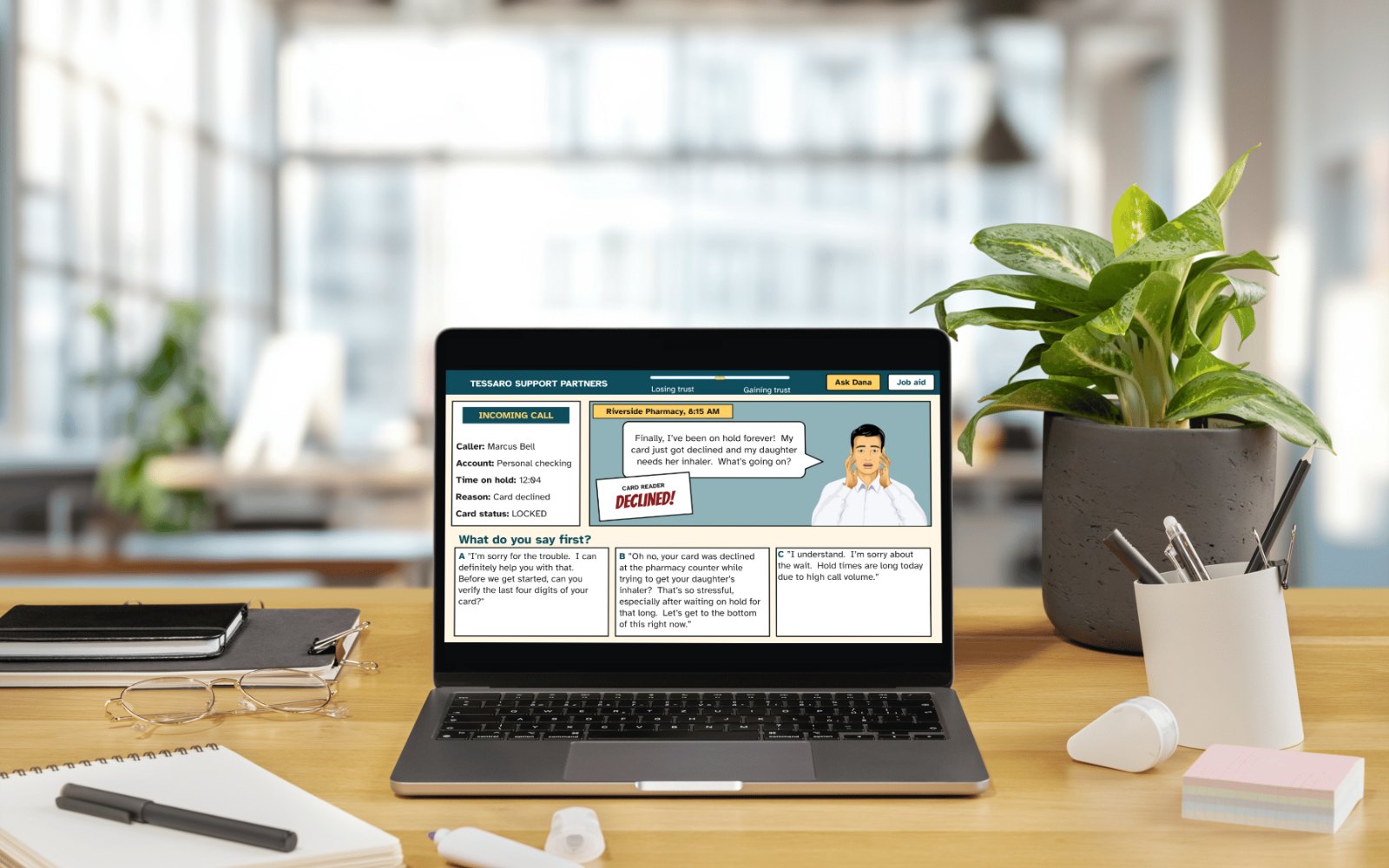
Each A became one decision in the story. Learners help Marcus Bell, whose card was locked after a fraud attempt and declined while he was picking up his daughter's inhaler. Dana Reyes, the learner's team lead, offers optional hints. A trust meter on every slide shows how each choice lands.
Design decisions and tradeoffs
A hybrid format
Fixed branching choices let me control the teaching, because every option shows a specific strength or mistake. But a real call requires producing an answer, not recognizing one. So the course ends with a live AI round where learners type their own replies.
Paths that converge, with a running trust score
A rough start doesn't doom a real call if the agent recovers well. The paths converge after each decision and trust carries forward, so a learner can lose trust early and still earn it back. The ending depends on the final score: a loyal customer, a shaky relationship, or an escalation.
Realistic wrong answers
New hires don't choose obviously rude answers. They choose answers that sound reasonable but miss the point, like blaming another team or reversing a policy meant to protect them. I was careful that the correct answer never stood out because of its length, tone, or level of detail, so learners have to think through each choice instead of spotting the obvious one.
A cold open
The course opens on the angry customer instead of a list of objectives, so the learner feels the problem before being taught the fix.
Scope cuts to meet a fixed deadline
I had a firm 14 day deadline. I cut voices and sound, kept the AI round to one industry (banking), and capped the call at five replies. That time went into a well tested core instead of a wider, shallower course.
The live AI round
The learner takes a call from Jordan Ellis, whose mortgage payment was withdrawn twice because of a bank error. Checking is overdrawn, two overdraft fees posted, and two bills bounced. After each reply, Jordan responds in character, the trust meter moves, and Dana gives a one line coaching tip. After five replies, Dana gives feedback on each A.
Storyline can't call an AI service safely on its own, because the key would be exposed in the published course. I set up a free Cloudflare Worker that sits between the course and the AI. The key is stored only as a Cloudflare secret. The relay also holds the case details and scoring instructions, so I can refine the prompt without republishing the course. If Gemini is busy, it falls back to other models.
What testing taught me
- The scoring was too harsh. Reasonable new hire replies lost trust. I added a fair, encouraging rubric with example replies for each score.
- The AI asked for things a bank can't do. Jordan kept asking the agent to fix things with the mortgage, insurance, and phone companies. From experience, I knew a bank can't act for other companies, so I rewrote the case around what the agent can really offer.
- The standard fix had to be realistic. I made a bank error letter the standard solution and reserved a three way call for highly escalated situations.
- Feedback had to match the lesson. I caught Dana suggesting an "I understand" line, which the course teaches agents to avoid, and fixed the instructions so it can't happen.
The job aid
A course alone fades, so learners leave with a one page quick guide they can keep at their desk. Each A has a goal, a "say" example, and an "avoid" example, because new hires learn quickly from seeing the near miss next to the right move. It also covers the signs that trust is slipping and when to bring in a lead. Escalating comes after trying all 3 A's, which supports the business goal.
Accessibility
My target was WCAG 2.1 AA, built into the design rather than added at the end.
- Heading levels set on every slide so screen reader users can navigate.
- Alt text that names each character and their mood, since mood carries the story. Decorative shapes are marked decorative.
- The trust meter is labeled so its meaning is clear without seeing it.
- Atkinson Hyperlegible, a typeface designed for readers with low vision.
- 0 issues in Storyline's accessibility check, and a full keyboard only test.
How AI supported my process
I used Claude as a coding partner. It drafted the relay code and the JavaScript that connects Storyline to the relay, and helped me troubleshoot when something didn't work.
I made the decisions: the problem, the audience, the model, the format, and the scope. I rewrote wording whenever it didn't sound like a real call, built everything in Storyline, set up the relay, and tested it. My testing found the problems that drove the fixes above. I didn't let AI invent facts about my experience, and I kept the API key private.
Proposed evaluation plan
Because Tessaro is fictional, this is a plan rather than results. It follows the four Kirkpatrick levels.
| Level | What I would measure |
|---|---|
| 1. Reaction | A short survey after the course on relevance and confidence handling a frustrated customer. |
| 2. Learning | Decision results and AI call scores for each A. |
| 3. Behavior | Quality reviews of real calls during the first 90 days, looking for each of the 3 A's. |
| 4. Results | The supervisor escalation rate for new hires, compared with a baseline before the course. |
Next step: usability testing with two to three people, then revisions based on what I learn.